If you’ve shopped for a new air conditioner or heat pump lately, or had a technician tell you your older system “uses the old refrigerant,” you’ve run into one of the biggest changes to home cooling in years. The refrigerant that’s been in nearly every new residential AC installed since about 2010, R-410A, is being phased down, and new equipment has moved to a different refrigerant — for most of the industry, including Bryant, that’s R-454B.
There’s a lot of confusing and sometimes outdated information floating around about this, including deadlines that have since changed. Here’s what actually applies, what it means for a typical Twin Cities home, and how to think about repairing versus replacing an older system.
Why refrigerants are changing again
Refrigerant is the fluid your AC or heat pump pumps between the indoor coil and the outdoor unit to move heat. Older systems used R-22, which was phased out because it damages the ozone layer. Its replacement, R-410A, doesn’t harm ozone, but it’s a hydrofluorocarbon (HFC) with a high global warming potential (GWP) — a measure of how much heat a gas traps compared to carbon dioxide if it leaks into the atmosphere.
In 2020, Congress passed the American Innovation and Manufacturing (AIM) Act, which directs the EPA to phase down production and import of HFCs over time and to restrict high-GWP HFCs in specific kinds of new equipment. Under the EPA’s Technology Transitions rules, new residential and light commercial air conditioning and heat pump systems must use a refrigerant with a GWP below 700. R-410A is well above that limit. R-454B, which Bryant calls Puron Advance, has a GWP of 466 — Bryant describes it as a roughly 75% reduction compared to R-410A.
The dates that actually matter
The rules have been adjusted since they were first written, so it’s worth being precise. According to the EPA:
- Since January 1, 2025, manufacturers and importers can no longer produce new residential and light commercial split AC and heat pump systems that use refrigerants with a GWP of 700 or higher, like R-410A.
- The original rule also set January 1, 2026 as the last day to install new split systems built with R-410A components made before 2025. In a final rule published in May 2026 and effective July 27, 2026, the EPA removed that installation deadline for systems where all of the specified components were manufactured or imported before January 1, 2025.
- Repairing an existing R-410A system is still allowed. Components used to service and repair an existing system aren’t subject to the new-system restrictions.
In plain terms: your current R-410A system can keep running and be repaired. Leftover R-410A equipment built before 2025 can still legally be installed while it lasts, but no new R-410A equipment is being made, so that supply shrinks over time. And the AIM Act phase-down keeps reducing how much HFC refrigerant is produced overall, which affects how much R-410A is available for service in the years ahead.
What “A2L” means, and whether it’s safe
R-454B and R-32 (the other common new refrigerant, used by some other manufacturers) are classified as A2L refrigerants. The “A” means lower toxicity. The “2L” means lower flammability — often described as “mildly flammable.” They’re hard to ignite and burn slowly if they do, which is very different from something like propane. R-410A, by comparison, was classed as nonflammable.
Because of that change, the equipment itself was redesigned. Bryant states that its Puron Advance products include a refrigerant leak detector and a dissipation system: if the sensor detects refrigerant, the system turns on the indoor fan to dilute and disperse it so it can’t build up. Safety standards and building codes were updated to account for A2L refrigerants as well, covering things like charge limits, sensors, and how systems are installed.
For homeowners, the practical takeaway is that a properly designed and installed A2L system is safe, and the sensor and mitigation board are safety devices — not optional add-ons to skip or disconnect. For installers, it means new procedures, tools rated for A2L refrigerants, and training on handling, recovery, and brazing practices specific to these systems. That’s one reason who installs your system matters more now than it used to. Our NATE-certified technicians work with this equipment as a Bryant Factory Authorized Dealer.
You can’t just mix old and new parts
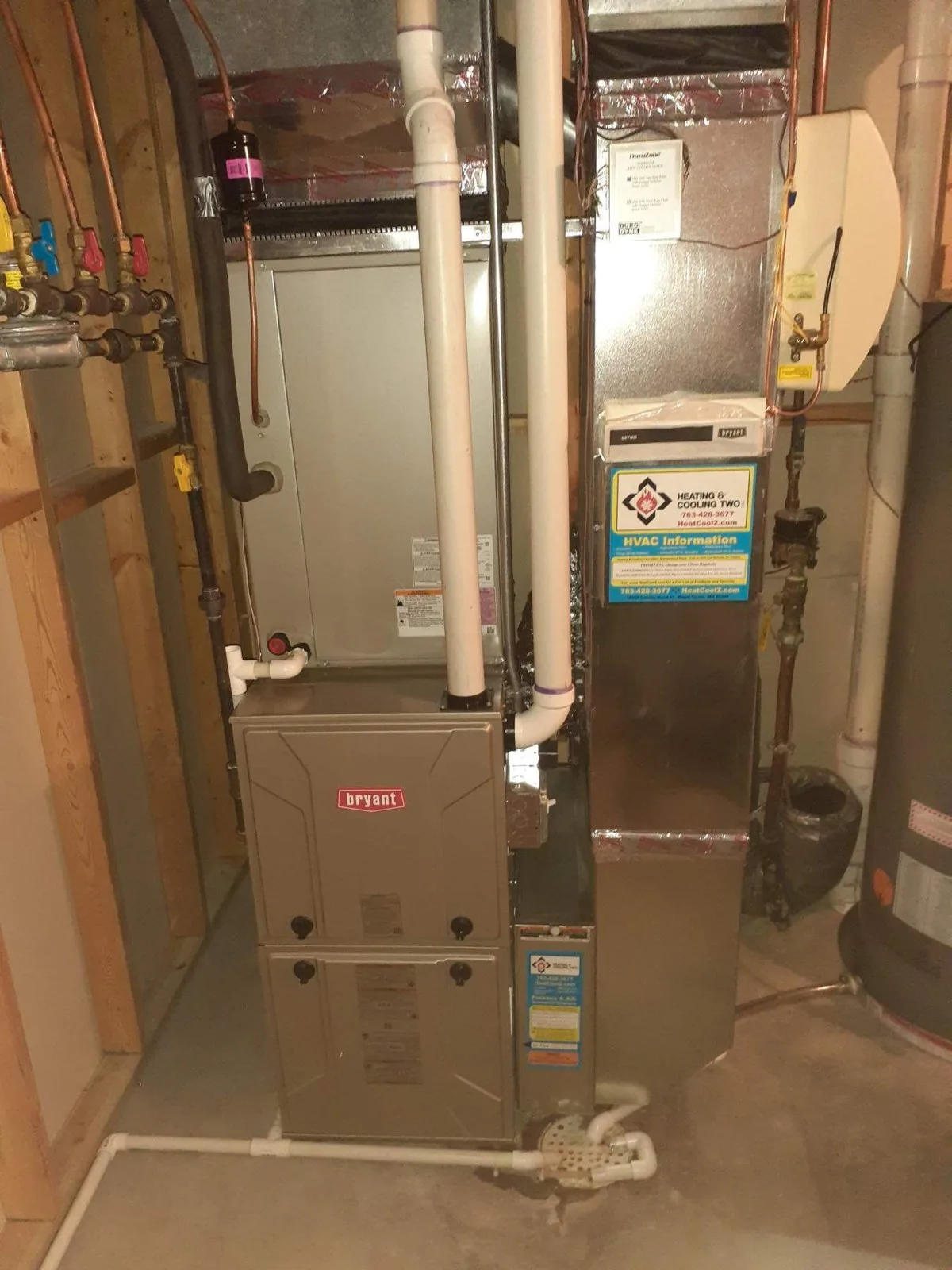
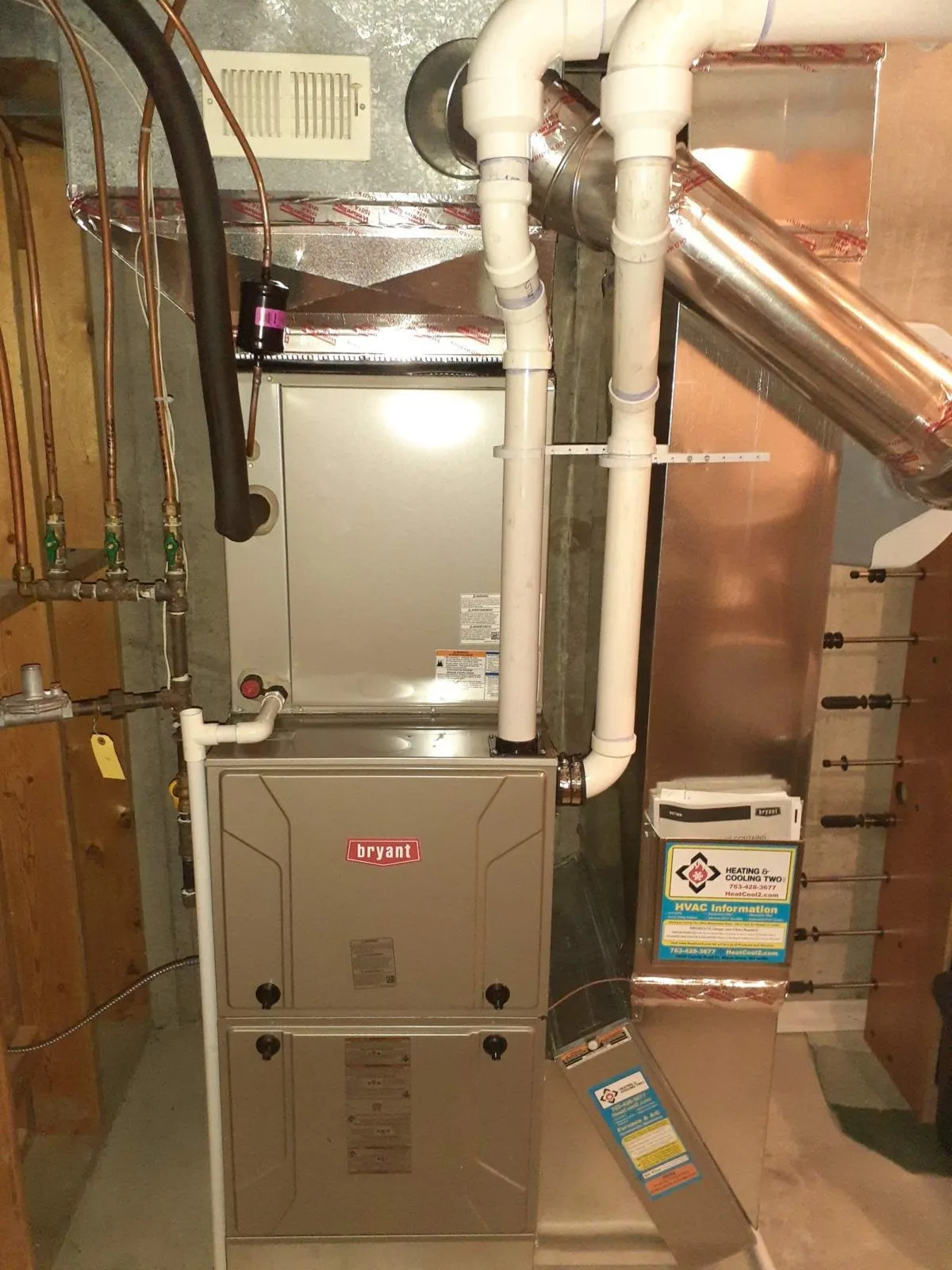
A central AC or heat pump is a matched system: the outdoor unit, the indoor coil that sits on top of your furnace, and the refrigerant metering device are designed and rated to work together with one specific refrigerant. R-454B equipment is designed differently from R-410A equipment, and the indoor coil on an A2L system typically includes the leak sensor that the safety system depends on.
So if your outdoor unit fails and it’s an R-410A system, the choices are basically to repair it with R-410A parts, find a compatible R-410A replacement that was made before 2025, or replace the outdoor unit and the indoor coil together with a new matched A2L system. Putting a new R-454B condenser on an old R-410A coil isn’t an option, and neither is topping off an old system with the new refrigerant. The line set (the copper refrigerant pipes between the units) can sometimes be reused if it’s the right size and in good condition, but that’s a judgment call made on site, often after cleaning and pressure testing.
This matched-system rule is also why it often makes sense to look at the furnace at the same time. If your furnace is near the end of its life, replacing both together avoids paying for labor twice. Our post on furnace repair or replace walks through that decision.
If your AC is 10+ years old
A lot of homes around the NW metro have R-410A systems installed somewhere in the 2008–2016 range. If yours is running well, there’s no reason to rip it out because of the refrigerant change. Keep up with annual AC maintenance so small problems get caught early, and keep an eye on the kinds of repairs it needs.
Where the refrigerant change really comes into play is a big repair. A refrigerant leak, a failed compressor, or a failed indoor coil on an older R-410A system is where you have to weigh the cost of fixing it — including refrigerant that’s likely to get more expensive as supply tightens — against moving to a new matched system. We can’t predict exact prices, but the general direction is clear: as production is stepped down and no new R-410A equipment is made, service refrigerant and replacement parts for R-410A systems are more likely to get scarcer and more expensive over time than cheaper.
A leaking system is the key red flag. Adding refrigerant without finding and fixing the leak just means paying for it again later, and on an aging system with a leaking coil, the math often points toward replacement.
If your AC still uses R-22
If your system is old enough to use R-22 (typically installed before about 2010), you’re already well past this debate. Production and import of R-22 ended on January 1, 2020, so what’s left for service is recovered, reclaimed, or stockpiled refrigerant, and it’s expensive. An R-22 system that’s still cooling can keep running, but any major repair — especially one involving a leak or the compressor — is almost always a good moment to replace it. Planning that on your own schedule is much better than doing it during the first heat wave of July.
Efficiency standards: SEER2 in the North region
Separately from refrigerants, efficiency ratings changed on January 1, 2023, when the Department of Energy switched to new test procedures called SEER2, EER2, and HSPF2. The new tests more closely reflect real-world duct conditions, so SEER2 numbers look a bit lower than old SEER numbers for the same equipment.
Minnesota falls in the DOE’s North region. There, new split-system central air conditioners must be at least 13.4 SEER2, and new split-system heat pumps must be at least 14.3 SEER2 and 7.5 HSPF2 (HSPF2 measures heating efficiency). Those are floors, not recommendations. Higher-efficiency equipment, especially two-stage and variable-speed systems, costs more up front but uses less electricity and often qualifies for utility rebates. See our rebates page for the programs we help customers with.
If you’re going to replace, it’s also a good time to consider whether a heat pump makes sense for your home. Modern cold-climate heat pumps paired with a gas furnace backup work well here, and they use the same new refrigerants.
How we’d approach your system
If your AC is working, keep it maintained and don’t let anyone pressure you into replacing it only because of the refrigerant change. If it needs a repair, get a clear diagnosis first: what failed, what refrigerant it uses, how old the system is, and what the repair includes. Then compare that against a proper replacement quote for a matched system sized for your home — not a rule-of-thumb guess.
Heating & Cooling Two has been installing and servicing cooling systems in the Twin Cities since 1980. If your AC needs attention, schedule an AC repair visit, or if you’re ready to explore new equipment, request a free estimate for AC installation. You can also call us at 763-428-3677.

 By
By