Bryant vs. Carrier: Are They the Same Furnace? A Minnesota Buyer's Guide
Bryant and Carrier are made by the same company. What's the same, what's different, how the furnace lines match up, and what matters more than the brand name.
Read article
How to run an air exchanger (HRV or ERV) in a Minnesota winter: which mode to use, humidity targets by outdoor temperature, frozen cores, filters and when to call.
Family-owned since 1980
Three generations of Twin Cities neighbors keeping homes and businesses comfortable.
NATE-certified technicians
Factory-trained, background-checked techs who explain the work before they start.
Bryant Factory Authorized Dealer
Top-tier equipment, factory warranties and rebates you can only get from an authorized dealer.
November 14, 2026 · 10 min read
 By Trevor Torgerson, Manager, Sales & Operations
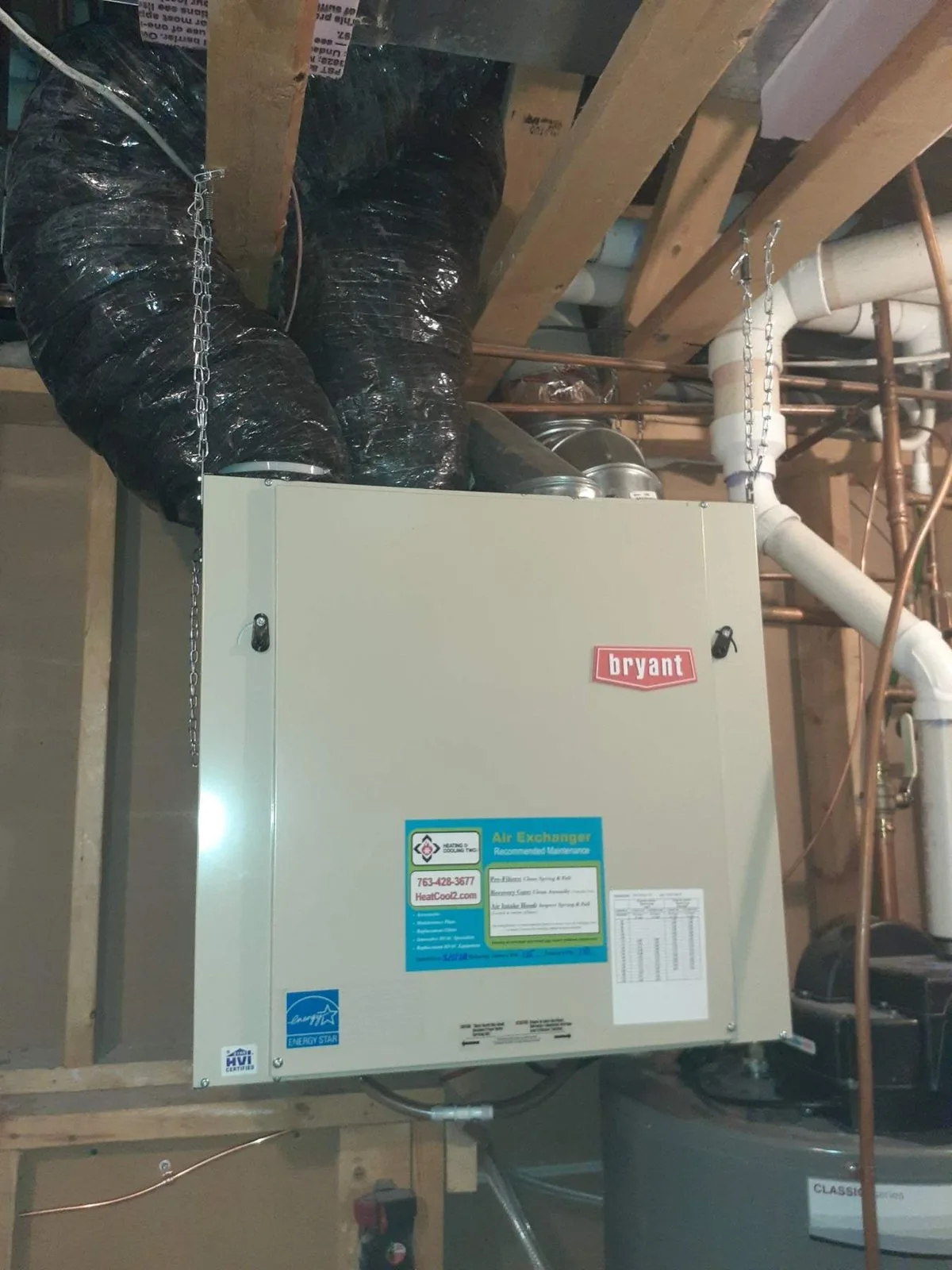
Leave your air exchanger on all winter. In most Twin Cities homes, the right winter setup is to run it on its low or continuous setting, or on the intermittent schedule your installer set, and use high speed for short bursts when the house gets steamy. If your control has a dehumidistat, set it to match the outdoor temperature: lower in a cold snap, higher when it warms up. Then keep the filters clean and the outdoor hoods clear of snow.
That's the short answer. Below is what each setting does, how to choose your humidity number, why a little frost or a defrost cycle is normal, and the signs that your air exchanger needs a service visit instead of another button press.
An air exchanger is a ventilation system. It pulls stale, moist air out of the house (usually from bathrooms, the kitchen area or a central return) and brings the same amount of fresh outdoor air in. Most homes around the metro have a heat recovery ventilator, or HRV. Inside the box, the two airstreams pass through a core without mixing, so the warm air going out pre-warms the cold air coming in. Natural Resources Canada's homeowner guide to HRVs notes that a typical HRV recovers about 70 percent of the heat from the exhaust air.
An energy recovery ventilator, or ERV, works the same way but also moves some moisture across the core. In winter that means an ERV holds on to a bit more indoor humidity than an HRV does. Most of the advice below applies to both. Where it differs, we'll say so.
One thing an air exchanger is not: a heater or an air cleaner. It doesn't heat the house and it doesn't replace your furnace filter. Its job is to swap old air for fresh air so moisture, odors, cooking fumes and other indoor pollutants don't build up.
Homes built in the last couple of decades in places like Maple Grove, Rogers, Otsego and Plymouth are much tighter than older houses. That saves energy, but it also traps moisture and indoor pollutants that used to leak out through drafty walls. Minnesota's residential energy code (Minnesota Rules chapter 1322) now requires new homes to have a balanced mechanical ventilation system. The air coming in has to be within 10 percent of the air going out.
The code also sets how much air the system has to move. The total ventilation rate is 0.02 cubic feet per minute (cfm) for every square foot of living space, plus 15 cfm for every bedroom plus one. A 2,000-square-foot home with three bedrooms works out to about 100 cfm. At least half of that has to run continuously, and the continuous rate can't be less than 40 cfm. In plain terms, your air exchanger was designed to run all the time at a low level, not to be switched on once in a while.
The Minnesota Department of Commerce's guide to balanced ventilation explains why balance matters. When exhaust and supply are even, the house isn't pulled into negative pressure, which can draw cold air in through cracks or pull exhaust gases back down a chimney or flue.
Controls vary by brand, but most wall controls for air exchangers have some version of these modes:
The right indoor humidity in winter depends on how cold it is outside. When outdoor air is frigid, your windows and the inside surfaces of exterior walls get cold too, and moisture that would be fine in October will condense on them in January. University of Minnesota Extension's guidance on controlling moisture problems is to keep indoor relative humidity around 25 percent in winter to 50 percent in summer.
The Center for Energy and Environment in Minneapolis publishes a simple chart for managing indoor humidity by outdoor temperature. Use it as your dehumidistat guide:
So if the forecast says it'll be 5°F all week, set the dehumidistat around 30 percent. When an Alberta clipper drops it below zero, turn it down to 25 or lower. When it warms back into the 20s, you can raise it again. If your windows are sweating at the bottom corners in the morning, your humidity is too high for the current weather, no matter what the number on the control says. Our post on window condensation and indoor humidity walks through that in more detail.
A $15 to $40 digital hygrometer is worth having. The humidity reading on an air exchanger control or thermostat can be off by several points, and a second opinion on a shelf away from the kitchen and bathrooms tells you what's really going on.
This is the most common mix-up we see. A whole-house humidifier on the furnace adds moisture. An air exchanger running on its dehumidistat removes moisture. If both are set to chase a humidity number, they can fight each other all winter: the humidifier pushes humidity up, the air exchanger senses it and kicks to high speed, and you pay to heat extra outdoor air while the humidifier works overtime.
The usual fix is to let one control own the humidity. Run the air exchanger on its continuous or intermittent schedule for fresh air, set its dehumidistat high enough that it doesn't react to the humidifier, and let the humidifier's control (ideally one with an outdoor temperature sensor) set the humidity level. If you have an ERV and the house still feels dry, you may not need much added humidity at all. Our whole-house humidifier guide covers humidifier settings, and our team can set up both pieces to work together during a visit.
When it's very cold outside, moisture in the outgoing air can freeze in the core. HRVs have a defrost mode for this. According to Natural Resources Canada, defrost typically starts when outdoor temperatures fall below about -5°C (23°F), and the colder it gets, the longer and more often the unit defrosts.
During defrost, many units briefly stop bringing in outdoor air or recirculate warm indoor air through the core. You may hear a damper click or notice the fan change speed. That's normal. It also means your home gets a little less fresh air during a deep cold snap, which is one reason humidity can creep up in January even when nothing is wrong.
Windows sweating every morning: lower the dehumidistat setting to match the outdoor temperature chart, run a bathroom timer during and after showers, and make sure the air exchanger is actually on. Units get switched off and forgotten more often than you'd think, especially after a power outage or a remodel.
House feels too dry, static shocks, cracked skin: the air exchanger may be moving more air than the house needs. Check that it isn't stuck on high or on a dehumidistat setting that's too low. If you have an intermittent setting, try it. If the house is always dry with the air exchanger on low, the airflow may need rebalancing, or an ERV may be a better fit.
Cold draft from a supply register: fresh air from an HRV is pre-warmed but still cooler than room air in deep cold. Supply registers placed high on walls or ceilings help. If the draft is new, a frozen or dirty core or an airflow imbalance can be the cause.
Musty smell: check the filters and the core for dust and debris, and make sure the condensate drain line isn't clogged. A dry drain trap can also let odors in.
Snow and ice at the outdoor hoods: clear them after every big storm. A blocked intake starves the unit of air, and a blocked exhaust can make it freeze. While you're out there, check your furnace and water heater vents too. Our guide to furnace vent pipes, snow and ice shows what to look for.
Air exchangers are low-maintenance, not no-maintenance. Here's the schedule Natural Resources Canada and the Minnesota Department of Commerce recommend, put into plain steps:
Call a technician if the core keeps freezing, water collects under the unit, the windows still sweat with the humidity set correctly, the motor is noisy or the unit won't respond to its control. Natural Resources Canada notes that an HRV with a core that keeps freezing may need its airflows rebalanced. That's also true after a basement finish or remodel, when ducts sometimes get moved, crushed or disconnected.
We look at air exchangers as part of a furnace tune-up, which makes it easy to check both once a year. Our maintenance plans include priority service, and you can read more about ventilation, filtration and humidity on our indoor air quality page. For a bigger picture of keeping the air healthy when the house is closed up, see our post on indoor air quality in a Minnesota winter.
Heating & Cooling Two is a family-owned company that has served the Twin Cities since 1980 and a Bryant Factory Authorized Dealer. We service air exchangers, humidifiers and furnaces together, so the whole system works as a team instead of fighting itself. Request service or a free estimate online, or call 763-428-3677. Office hours are Monday through Friday, 7:30 a.m. to 4:30 p.m., weekends by appointment, and after-hours emergency service is available.
Keep reading
Bryant and Carrier are made by the same company. What's the same, what's different, how the furnace lines match up, and what matters more than the brand name.
Read article
Replacing a furnace in the Twin Cities? How an 80% and a 96% AFUE furnace really differ in gas use, venting and rebates, and when each one makes sense.
Read article
A furnace that runs nonstop on a subzero night may be fine. When constant running is normal, when it means trouble, and what to check before you call.
Read articleFree estimates and straight answers across the Twin Cities. After-hours emergency service available.