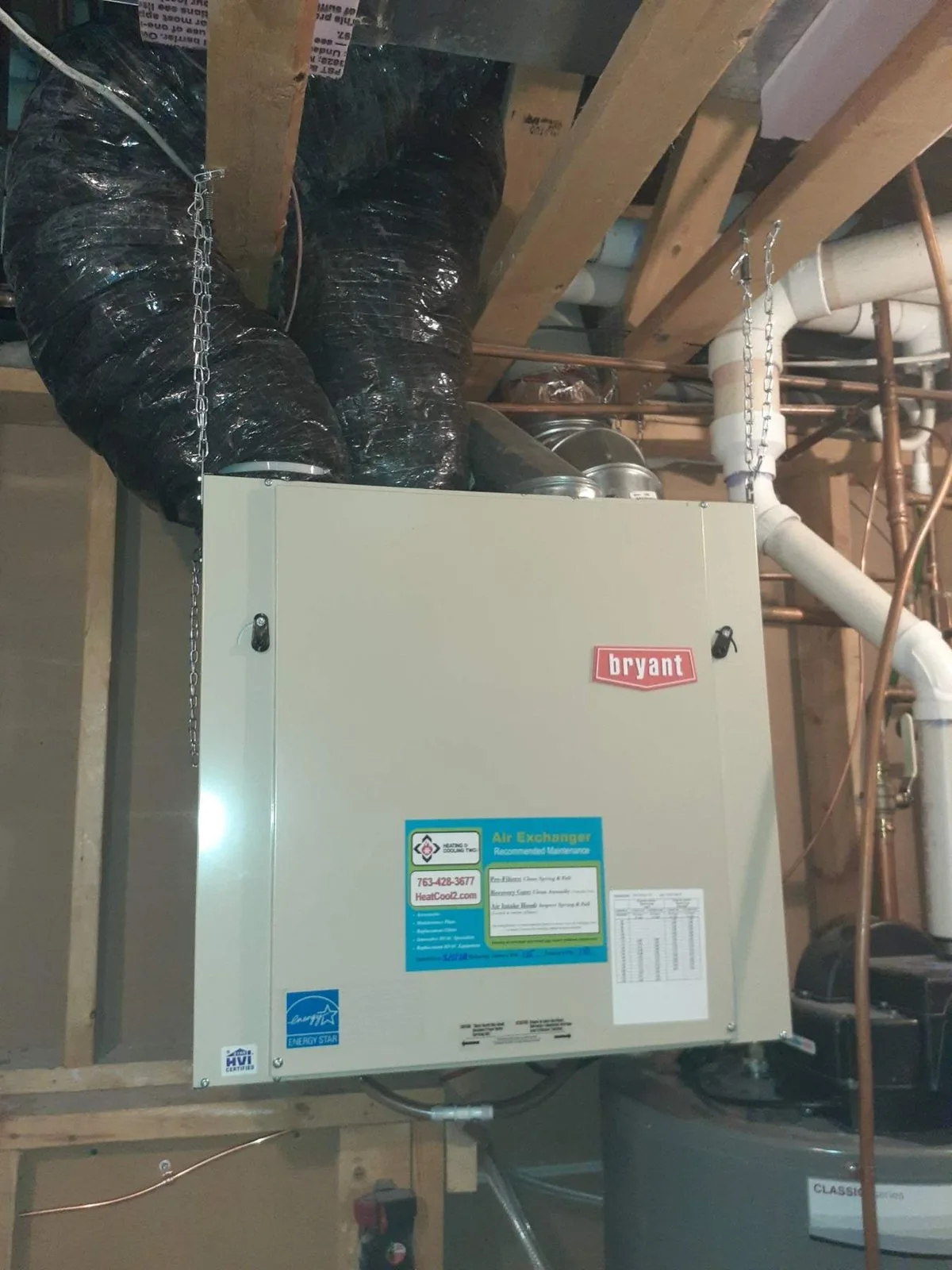
Air Exchanger Settings for a Minnesota Winter: How to Run Your HRV
How to run an air exchanger (HRV or ERV) in a Minnesota winter: which mode to use, humidity targets by outdoor temperature, frozen cores, filters and when to call.
Read article
Bryant and Carrier are made by the same company. What's the same, what's different, how the furnace lines match up, and what matters more than the brand name.
Family-owned since 1980
Three generations of Twin Cities neighbors keeping homes and businesses comfortable.
NATE-certified technicians
Factory-trained, background-checked techs who explain the work before they start.
Bryant Factory Authorized Dealer
Top-tier equipment, factory warranties and rebates you can only get from an authorized dealer.
November 14, 2026 · 10 min read
 By Trevor Torgerson, Manager, Sales & Operations
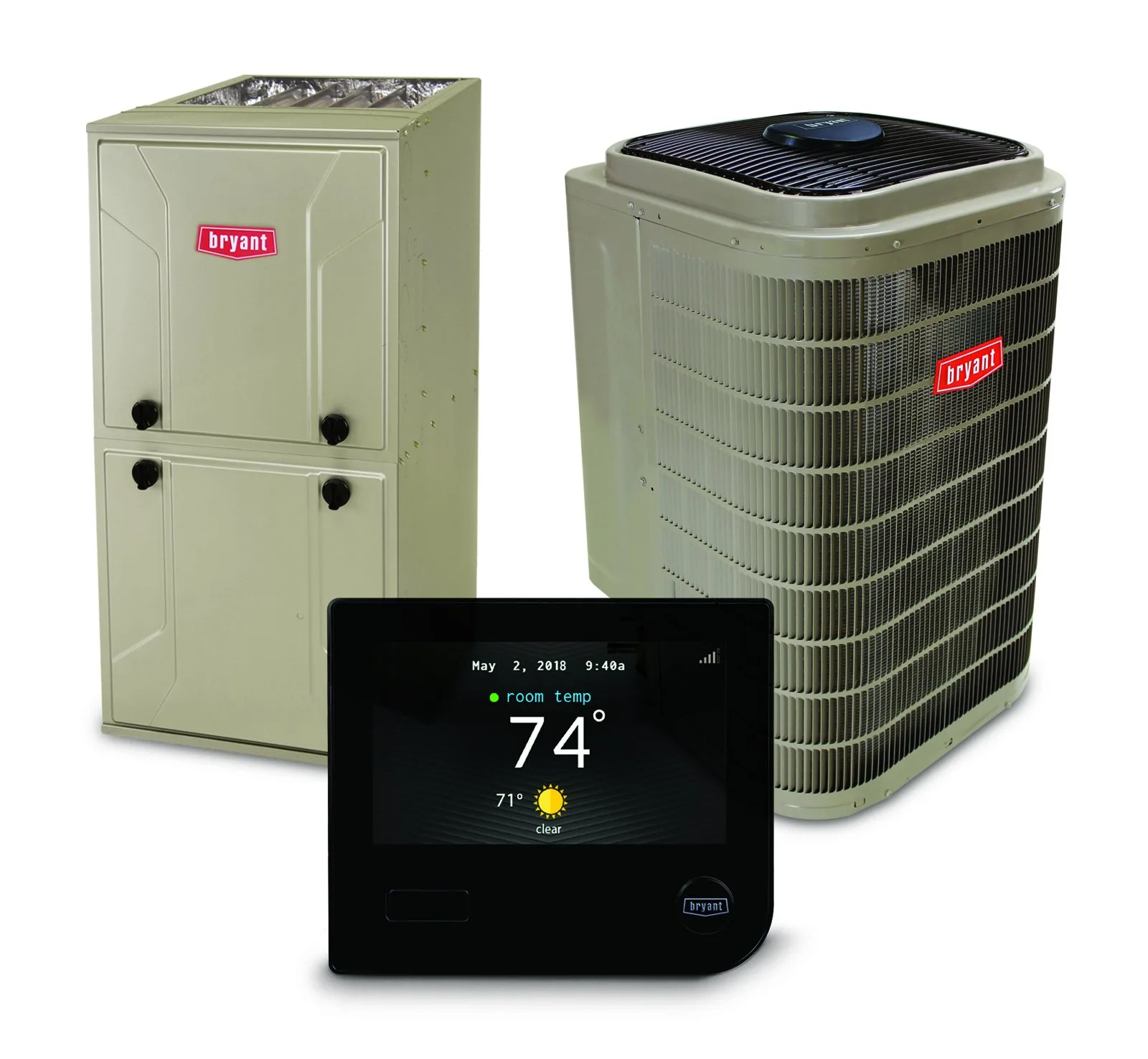
Yes, mostly. Bryant and Carrier are both owned by Carrier Global, and Bryant has been part of the Carrier family since 1955. Each Bryant furnace line has a Carrier twin with the same efficiency, the same type of burner and blower, and largely the same engineering. The real differences are the badge, some warranty program details, the dealers who sell each brand and, often, the price.
That means the more useful question for a Twin Cities homeowner isn't Bryant or Carrier. It's whether the furnace is the right size and type for your house, and whether the company installing it will do the job right and stand behind it. Here's how the two brands compare, how to match models across them, and what to look at when you have quotes in hand.
Bryant is the older name in home heating. Charles Bryant started the Natural Gas Regulator Company in Cleveland in 1904, and it became Bryant Heater & Manufacturing in 1908. In 1949, Bryant joined with Day & Night and Payne to form Affiliated Gas Equipment. Carrier bought that company in 1955, and Bryant moved to Indianapolis. Contracting Business has a good history of Bryant's first century.
Carrier itself was bought by United Technologies in 1979 and became an independent public company, Carrier Global, in April 2020. Today Carrier lists Bryant, Carrier, Payne and several other residential brands on its brands page. If you've been told that Bryant is a knockoff or a budget version of Carrier, that isn't accurate. They're sister brands from the same company.
Both brands sell three tiers. Bryant calls them Evolution, Preferred and Legacy. Carrier calls them Infinity, Performance and Comfort. Here's how current gas furnace models line up, based on each company's published specs on the Bryant furnace lineup and Carrier's product pages:
The pattern holds for older models too. A Carrier service bulletin's approved replacement chart pairs the Bryant 987M with the Carrier 59MN7, the 986T with the 59TN6, and the 926T with the 59TP6. It also states that Carrier and Bryant units can be replaced with either brand, as long as the replacement is a like unit.
Model numbers give you clues once you know the pattern. In Carrier's furnace models, a 58 at the start means an 80 percent furnace and a 59 means 90 percent or higher, according to Carrier's furnace buying guide. On both brands, the S, T or M in the model name tells you single-stage, two-stage or modulating. That letter matters more for comfort than the logo on the door. Our post on single-stage, two-stage and modulating furnaces explains the difference.
Because the furnaces are siblings, the real differences come down to a few things outside the cabinet.
Both brands use the same basic structure, and the most important rule is the same for both: register the equipment within 90 days of installation.
Bryant: many Bryant furnaces come with a 10-year parts limited warranty when registered within 90 days, or 5 years if not registered. Many models also carry a lifetime limited warranty on the heat exchanger, which drops to 20 years without registration. Bryant's Red Shield coverage adds a 10-year unit replacement limited warranty on the 987M, 986T and 880TA if the heat exchanger fails. Details are on Bryant's 987M product page and warranty information page.
Carrier: Carrier also offers a 10-year parts limited warranty and a lifetime heat exchanger warranty with registration. On eligible models sold by participating dealers, its Consumer Choice program lets you take 5 years of parts plus 3 years of labor coverage instead of the 10-year parts coverage, as described on Carrier's 59MN7 page.
Notice what's missing from the standard parts warranties: labor. When a part fails in year six, the part may be covered but the service call and labor usually aren't, unless your installer includes its own labor warranty or you buy extended coverage. Ask every company you get a quote from what labor coverage it offers and for how long. That answer can be worth more than any difference between the two brands.
Bryant's top dealer designation is Factory Authorized Dealer. According to Bryant, these dealers are evaluated on technical skills and business practices, have NATE-certified or union-card technicians, and offer Bryant's 100% Satisfaction Guarantee: if you're not satisfied with your new Bryant equipment within the first year, the dealer will fix it, or remove it and refund your money, subject to the program terms. ACHR News has reported that fewer than 5 percent of contractors hold the designation.
We're a Bryant Factory Authorized Dealer, so we're not neutral on this. But the honest point is this: the dealer program matters because installation quality matters. The same furnace can run quietly for 20 years or short-cycle and fail early depending on how it's sized, vented and set up.
On a Minnesota furnace, these details decide comfort, gas bills and how long the equipment lasts. Use them to compare quotes, whatever brand each company sells.
If you're holding one quote for a Bryant furnace and another for a Carrier, line them up model to model using the tier list above. A Bryant Preferred 927T and a Carrier Performance 59TP7 are a fair comparison. A Bryant Legacy single-stage against a Carrier Infinity modulating furnace isn't, and the price gap will mostly reflect the tier difference.
Then compare everything else on the quote: the size in BTUs and how it was calculated, any ductwork, venting or drain changes, the thermostat, the permit, labor warranty, haul-away of the old furnace and how quickly the company answers the phone on a cold night. Our guide to furnace replacement cost in the Twin Cities explains what's normally included and what drives the price up or down.
If your current furnace is nearing the end of its life, our post on how long a furnace lasts in Minnesota can help you decide whether to repair or replace. And if you already own a Carrier, we service Carrier and other brands too. Parts and diagnostics are very similar across the Carrier family.
Heating & Cooling Two is a family-owned company that has served the Twin Cities since 1980 and a Bryant Factory Authorized Dealer. On a free estimate, we'll measure your home's heat loss, look at your ductwork, venting and drain, and give you straight answers about which tier makes sense for your house and budget. Learn more about furnace installation and furnace replacement in Maple Grove, check our financing options, or request a free estimate. You can also call 763-428-3677. Office hours are Monday through Friday, 7:30 a.m. to 4:30 p.m., weekends by appointment, and after-hours emergency service is available.
Keep reading
How to run an air exchanger (HRV or ERV) in a Minnesota winter: which mode to use, humidity targets by outdoor temperature, frozen cores, filters and when to call.
Read article
Replacing a furnace in the Twin Cities? How an 80% and a 96% AFUE furnace really differ in gas use, venting and rebates, and when each one makes sense.
Read article
A furnace that runs nonstop on a subzero night may be fine. When constant running is normal, when it means trouble, and what to check before you call.
Read articleFree estimates and straight answers across the Twin Cities. After-hours emergency service available.