It is ten below, the house feels cooler than it should, and the registers are blowing nothing, or worse, cold air. Nobody likes that moment. The good news is that a fair share of the no-heat calls we take every winter turn out to be something a homeowner could have spotted in ten minutes: a thermostat that lost its batteries, a switch someone bumped, a furnace door that is not seated, or a vent pipe buried by last night's drift.
Here are the checks we would do first if we were standing in your basement, in order. Every one is safe for a homeowner: no opening the burner compartment, no touching gas controls, no bypassing safety devices. If the furnace still will not run afterward, you will have useful information for the technician.
Step 1: Start at the thermostat
The thermostat is the first thing we check because it is a common culprit. Make sure it is set to Heat, not Cool, Off, or Emergency Heat, and that the fan is on Auto. Then raise the setpoint three or four degrees above the current room temperature so there is no doubt the furnace is being asked to run.
If the screen is blank or dim, or you see a low-battery icon, replace the batteries. Many wall thermostats run on AA or AAA cells even when they are wired to the furnace, and a thermostat with weak batteries can look fine and still fail to call for heat. On a smart thermostat, check that a schedule or vacation hold is not overriding you; if it reports lost power, the problem may be at the furnace.
Then give it a few minutes. A modern furnace does not light instantly: a small fan called the inducer starts first, then the burners light, and the main blower usually waits about a minute before pushing warm air.
Step 2: Check power, including the switch you forgot you had
A gas furnace still needs electricity to run its controls, igniter, and blower. Look at your electrical panel for a tripped breaker labeled furnace or FAU. A tripped breaker usually sits in the middle position; push it firmly to Off, then back to On. If it trips again right away, leave it off and call us. A breaker that keeps tripping is telling you something is wrong.
Next, find the furnace service switch. It looks exactly like a light switch, usually on the wall or a joist near the furnace or at the basement stairs, and it gets turned off by accident more often than you would believe. Make sure it is on.
While you are at the furnace, look at the front door panels. Most furnaces have a door safety switch, a small push-button that cuts power whenever the blower door is off or not fully seated. If someone changed the filter and put the door back slightly crooked, the furnace will act completely dead. Press the lower panel firmly into place and secure any latches. Never tape down that switch to run the furnace with the door off; it is there for safety.
Step 3: Look at the filter
A badly clogged filter starves the furnace of airflow. The heat exchanger overheats, a high-limit safety switch opens, and the burners shut off. You may notice the furnace running in short bursts, blowing lukewarm air, or quitting entirely. Pull the filter out and hold it up to a light. If you cannot see light through it, replace it, and check that the arrow on the frame points toward the furnace.
Minnesota winters are hard on filters because the furnace runs long hours from fall into spring. Our furnace tune-up checklist covers what a good maintenance visit looks at, filter included.
Step 4: Read the blinking light before you touch anything else
Most modern furnaces have a control board with a small status light, usually visible through a little window in the lower door. It is the single most useful thing you can report to a technician.
Before you turn the power off or reset anything, look at the light and count the flashes. Many boards blink a code, pause, and repeat, for example three flashes, a pause, three flashes. Then look for the code chart. It is normally a label printed on the inside or outside of the door panel, and it translates the flash pattern into plain words, such as a pressure switch that did not close, a limit switch that opened, or a flame that was not sensed. Take a photo of the light and a photo of the label with your phone.
Do this first because on many furnaces, cutting power clears the current code, and the clue is gone until it fails again. Telling us the flash pattern helps the technician arrive with the right parts.
If there is no light at all, go back to Step 2: the furnace likely is not getting power.
Step 5: Make sure gas is getting to the house
If other gas appliances are working, such as a gas stove, water heater, or fireplace, you know gas is reaching the house. If none of them work, the issue may be with the gas service itself, and your utility (CenterPoint Energy or Xcel Energy for most of the metro) is the right first call.
You may also see a manual shutoff valve on the gas pipe leading into the furnace. When the handle runs parallel to the pipe, it is open. If it is turned crosswise, someone closed it, and there may have been a reason. Do not simply reopen it and hope. Call us so a technician can find out why it was shut and check the appliance before gas goes back to it. And do not touch the gas valve or controls inside the furnace itself; that is technician territory.
Step 6: On high-efficiency furnaces, check the drain and the pipes outside
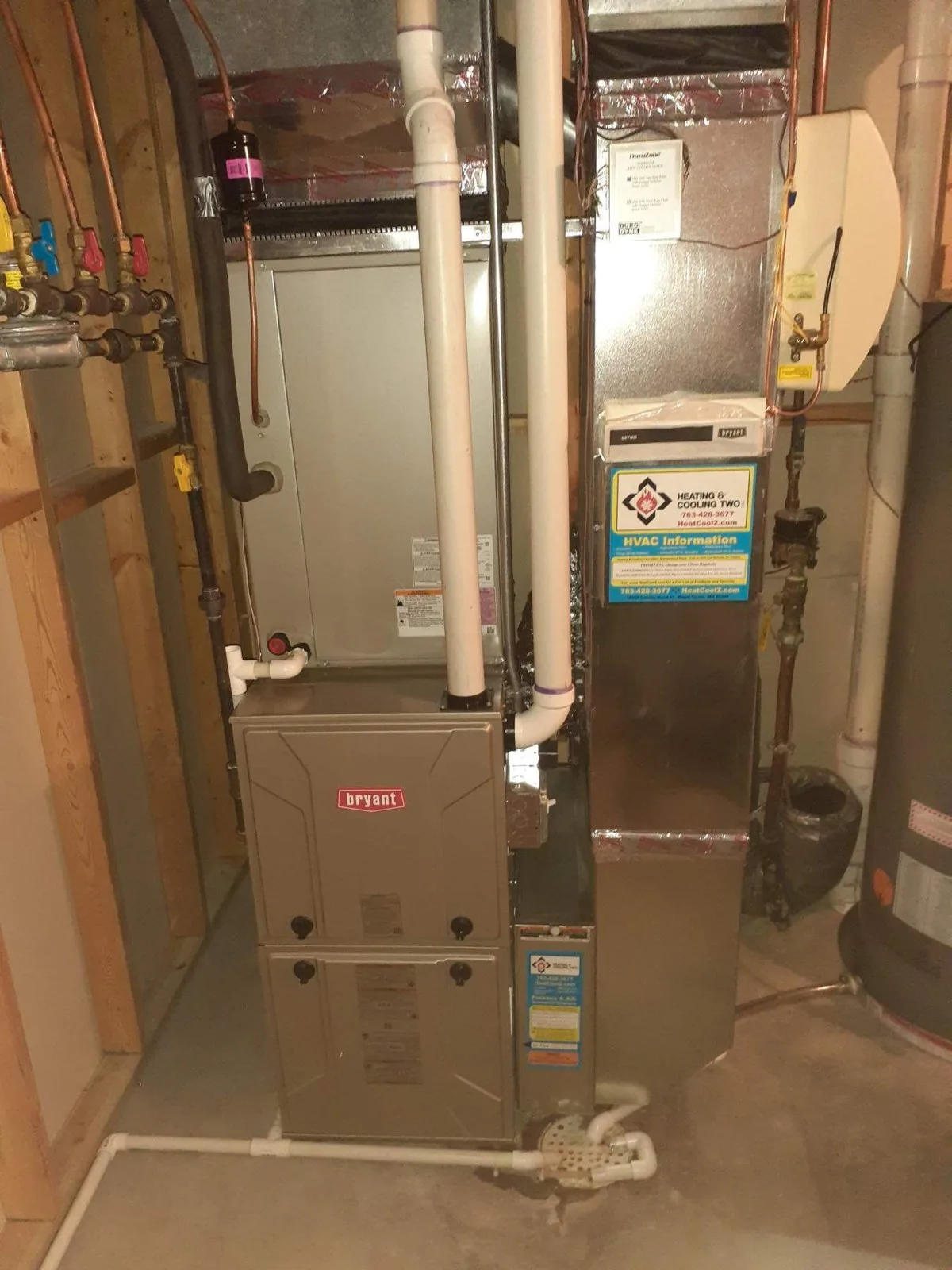
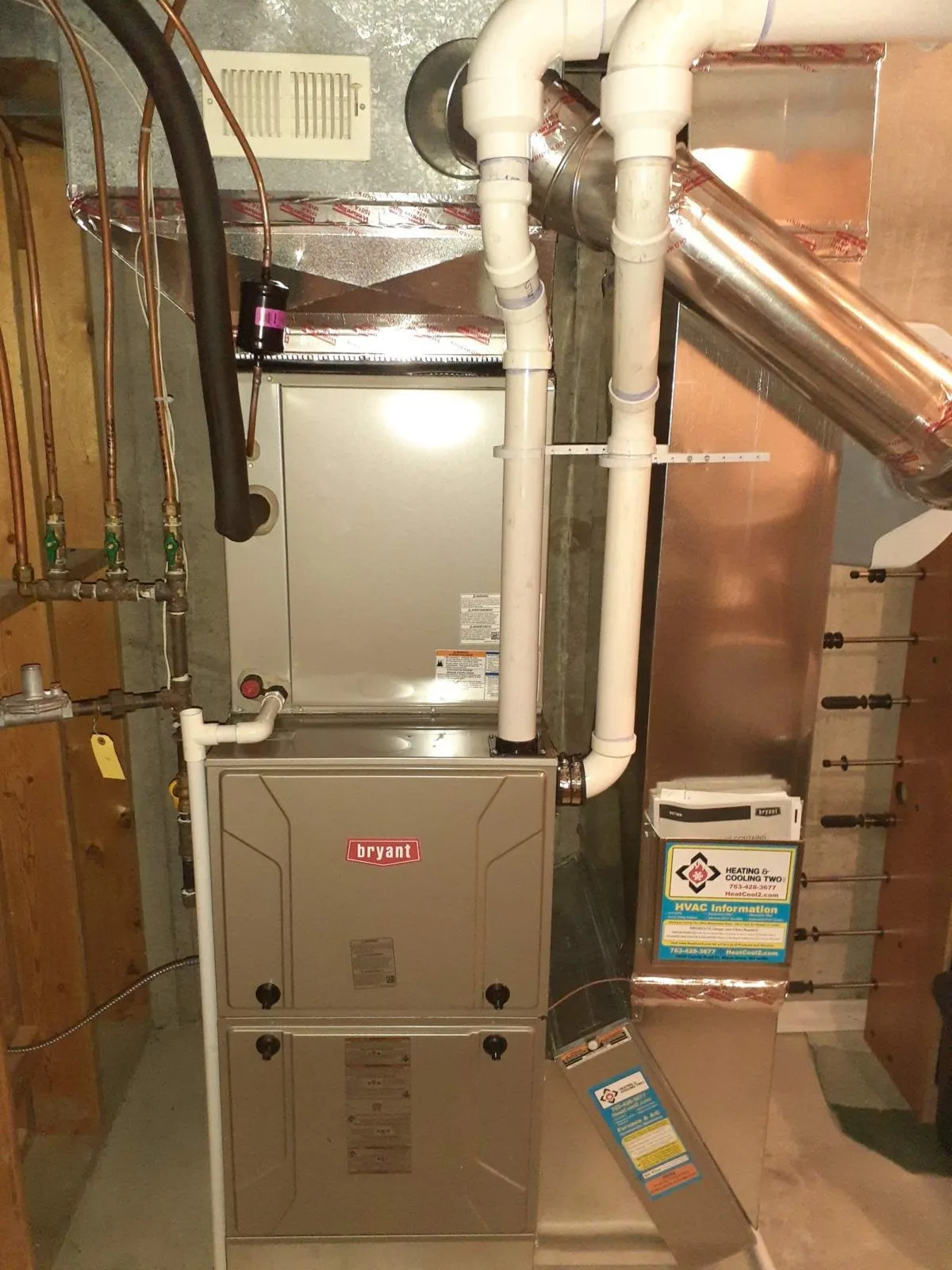
If your furnace has white plastic (PVC) pipes coming out of it instead of a metal flue, it is a high-efficiency condensing furnace. These furnaces pull so much heat out of the exhaust that water condenses inside them, and that water has to drain away through small hoses to a floor drain or a condensate pump.
Look at the condensate pump if you have one, a small plastic box near the furnace with a tube running to a drain or laundry tub. If it is full of water and not running, or you see water pooling around the furnace, the pump or drain may have failed. Many setups include a safety switch that shuts the furnace down when water backs up, and a clogged drain can also trigger a shutdown. Leave the furnace's internal drain trap to a technician.
Then go outside and find where those PVC pipes leave the house, usually through a side wall a foot or two above the ground, sometimes through the roof. After a heavy snowfall or a windy night, drifts can bury them, and frost can build up on the exhaust during long subzero stretches. When the pipes are blocked, the furnace's pressure switch will not let the burners light. Gently clear snow away by hand or with a soft brush, and do not chip at ice with anything hard. We cover this in detail in why furnace vent pipes block with snow and ice.
After you clear the pipes or fix a power problem, reset the furnace once by turning the service switch off for about a minute and back on. Once is enough. If it locks out again, call us.
What not to do
When the house is getting cold, it is tempting to keep trying things. Avoid these.
- Do not reset the furnace over and over. Safety controls lock the furnace out for a reason, and repeated restarts can flood the burners or push a failing part past the point of repair.
- Do not press any red reset buttons inside the furnace. Rollout and limit switches that trip are warning you about overheating or flames escaping where they should not; they need a technician to find the cause.
- Do not open the burner compartment or touch the gas valve, igniter, or flame sensor.
- Do not tape down the door safety switch or run the furnace with panels off.
- Do not use the kitchen oven, a gas range, a grill, a camp stove, or a generator to heat the house.
Keeping the house safe while you wait in a cold snap
In a Minnesota cold snap, a house without heat cools quickly, and pipes on outside walls are most at risk. Open cabinet doors under sinks on exterior walls so warmer room air can reach the pipes, let a faucet on each end of the house drip slowly, and keep the garage door closed if water lines run near it. Close off rooms you do not need and gather the family where it is warmest.
Portable electric space heaters can help, used carefully. The U.S. Consumer Product Safety Commission recommends keeping them at least three feet from beds, curtains, furniture, and anything else that can burn, plugging them straight into a wall outlet rather than a power strip or extension cord, keeping cords out from under rugs, and never leaving them running while you sleep or when no one is in the room.
Never use the oven, a gas stove top, a grill, a patio heater, or a generator to warm the house or attached garage. They produce carbon monoxide. Generators belong outside, well away from windows and doors.
When to stop and call right away
Two situations skip every step above. If you smell gas, often described as rotten eggs, do not flip light switches, use the thermostat, start a car in the garage, or do anything that could make a spark. Get everyone out of the house, then call your gas utility's emergency line or 911 from outside or a neighbor's house. Once the utility has made the house safe, call us to repair the furnace.
If a carbon monoxide alarm sounds, or anyone in the house has a headache, dizziness, nausea, or confusion that improves when they step outside, get everyone into fresh air and call 911 from outside. Minnesota law requires a working CO alarm within 10 feet of every room used for sleeping, and a furnace that is not working right is exactly when you want one. Our article on carbon monoxide, furnaces, and Minnesota law covers placement and testing.
Also stop and call if you see scorch marks, smell burning, or hear loud bangs when the burners light.
When the checks don't solve it
If you have worked through the list and the furnace still will not heat, that is the time to call. Tell us what you checked, what the status light is doing, whether it is a high-efficiency furnace with PVC pipes, and roughly how old the furnace is. That lets our NATE-certified technicians arrive prepared, which is the fastest way back to a warm house.
Our office is open Monday through Friday, 7:30 a.m. to 4:30 p.m., weekends by appointment, and after-hours emergency service is available. Call 763-428-3677 or learn more about our furnace repair service. If the furnace is older and this is not its first breakdown, read our guide on whether to repair or replace a furnace, and consider one of our maintenance plans to catch weak parts before the coldest night of the year does. Homeowners near our shop can learn more about furnace repair in Maple Grove.
 By
By