What to Set Your Thermostat to When You Leave Home in a Minnesota Winter
Leaving home this winter? The safe thermostat setting for a Minnesota house, plus a pre-trip checklist for pipes, furnace, vent pipes and water heater.
Read article
How Minnesota's Cold Weather Rule protects your heat Oct. 1 to April 30, who qualifies for Energy Assistance, and how to get help fixing a broken furnace.
Family-owned since 1980
Three generations of Twin Cities neighbors keeping homes and businesses comfortable.
NATE-certified technicians
Factory-trained, background-checked techs who explain the work before they start.
Bryant Factory Authorized Dealer
Top-tier equipment, factory warranties and rebates you can only get from an authorized dealer.
November 16, 2026 · 9 min read
 By Trevor Torgerson, Manager, Sales & Operations
If you're behind on your heating bill or your furnace just quit and you can't afford the repair, Minnesota has two programs that can help. The Cold Weather Rule protects most homes from having gas or electric heat shut off between October 1 and April 30, as long as you set up and keep a payment plan with your utility. The state's Energy Assistance Program can help pay heating bills, and for eligible homeowners, it can also pay to repair or replace a broken furnace.
Neither program is automatic. You have to contact your utility or your local Energy Assistance provider. Here's how each one works in plain English, who qualifies, and what to do if your heat is out right now.
The Cold Weather Rule is a Minnesota law that protects residential gas and electric customers from having their heat shut off from October 1 through April 30, according to the Minnesota Public Utilities Commission. Every natural gas and electric company in the state has to offer it, including city-owned utilities like Anoka Municipal Utility and electric cooperatives.
The key detail: it's not a free pass. To stay protected, you have to contact your utility, set up a payment plan and keep making the payments. The utility has to offer a plan that's reasonable for your household's finances. You don't have to be caught up on your bill to set one up, and you can do it any time during the season.
Under Minnesota Statutes section 216B.096, if your household income is at or below 50 percent of the state median income, a utility can't require you to pay more than 10 percent of your household income toward current and past heating bills under a Cold Weather Rule plan. If you receive Energy Assistance, that's often how you show you qualify.
If your income is above that line, you still have the right to a payment plan that takes your finances and any special circumstances into account. Keep the payments up and the utility can't disconnect you during the cold weather period.
The Minnesota Attorney General's Office also notes that during the Cold Weather Rule season, utilities generally can't disconnect service on a Friday, a weekend a holiday or the day before a holiday. Before a disconnection, the utility has to send a notice with your rights, payment plan options and a list of local energy assistance providers.
The Energy Assistance Program is run by the Minnesota Department of Commerce with local service providers across the state, and it's funded by the federal Low Income Home Energy Assistance Program. It's free, and both renters and homeowners can qualify.
According to the Department of Commerce, benefits can be up to $1,400 for the season and are paid straight to your utility or fuel supplier. There's also up to $600 in extra crisis help to prevent a shutoff, get reconnected, or pay for an emergency propane or fuel oil delivery. Eligibility depends on household size and income. Commerce gives the example that a family of four earning up to $73,969 a year can qualify for the 2026–2027 season. Applications are reviewed in the order they're received, and the deadline is May 31, 2027, so apply early.
This is the part of Energy Assistance most homeowners don't know about. Through the Energy Related Repair program, eligible homeowners can get help repairing or replacing a heating system that has stopped working or is unsafe. The Department of Commerce says the program supported emergency furnace repairs at more than 6,000 Minnesota homes last year.
Local providers explain the basic rules this way: you have to be approved for Energy Assistance, own and live in the home, and have no heat, a heating system that isn't working right, or a hazardous situation such as a cracked heat exchanger or a carbon monoxide problem. Providers generally can't pay for work they didn't approve ahead of time.
Start with the simple checks. Many no-heat calls turn out to be a setting or a part you can reset:
Never heat your home with a gas oven, a grill or a generator indoors. They release carbon monoxide, which can be deadly. If you use a space heater, plug it straight into a wall outlet, keep it three feet from anything that can burn, and never leave it running while you sleep or leave the room. To protect pipes, open cabinet doors under sinks on outside walls and let a thin stream of cold water run from those faucets.
Heating & Cooling Two is a family-owned company that has served the Twin Cities since 1980, with NATE-certified technicians and after-hours emergency service. We give honest repair-or-replace advice and never push a replacement when a repair will do. If you're paying for service yourself, ask about our financing options and check current rebates. Learn what to check when your furnace isn't working, what a cracked heat exchanger means, or book furnace repair. Call 763-428-3677 or request service online.
Keep reading
Leaving home this winter? The safe thermostat setting for a Minnesota house, plus a pre-trip checklist for pipes, furnace, vent pipes and water heater.
Read article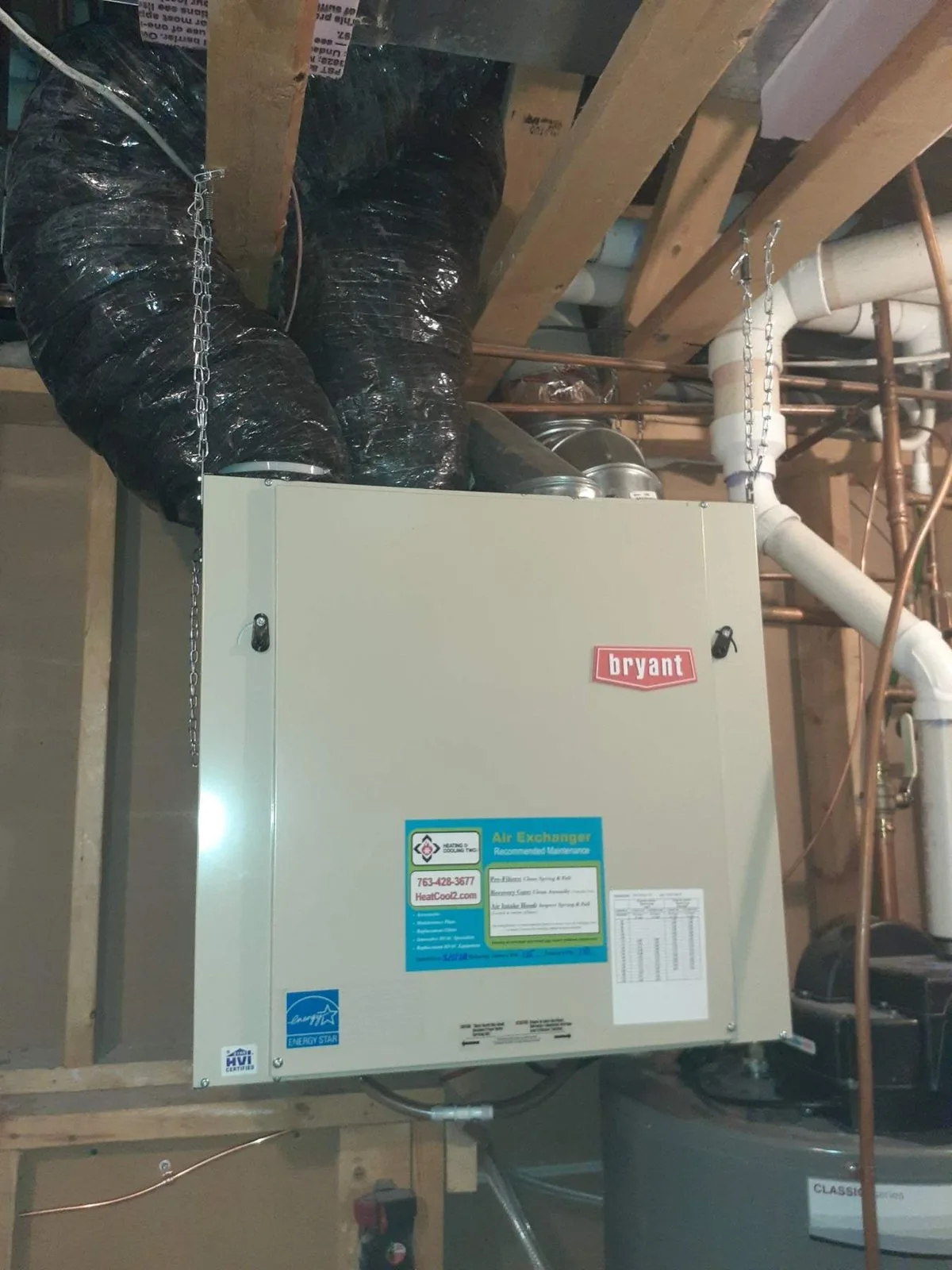
How to run an air exchanger (HRV or ERV) in a Minnesota winter: which mode to use, humidity targets by outdoor temperature, frozen cores, filters and when to call.
Read articleBryant and Carrier are made by the same company. What's the same, what's different, how the furnace lines match up, and what matters more than the brand name.
Read articleFree estimates and straight answers across the Twin Cities. After-hours emergency service available.